Most people land on personality frameworks the same way: they recognise themselves in one description, dismiss themselves in another, and walk away half-convinced they're a particular type without ever testing it properly.
That's a fine starting point. But "I think I'm probably a Red" and "you're 41% Red, 28% Blue, 18% Green, 13% Yellow" are not the same answer — and the second one tells you something the first one can't.
This guide is the honest middle ground. It walks through what each of the four DISC personality colors actually looks like in everyday behaviour, gives you concrete signals to spot in yourself, and then explains where self-assessment hits its ceiling.
A Quick Refresher on the Four Colors
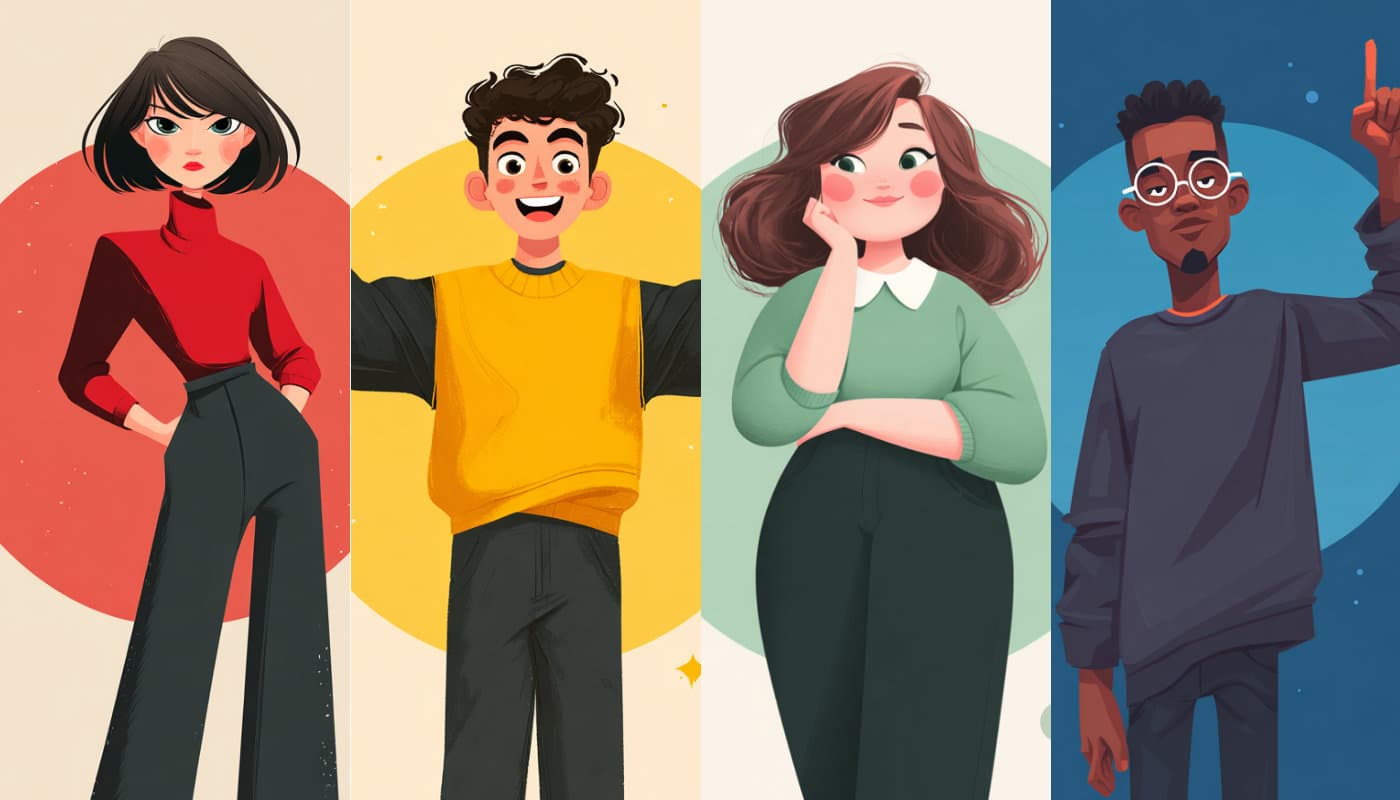
The DISC color framework breaks behaviour into four orientations: Red (drive, decisiveness, results), Yellow (energy, connection, persuasion), Green (stability, harmony, support), and Blue (precision, depth, quality). Everyone carries all four — what differs is the distribution. If you want the full background, the framework explainer covers where the model comes from and how the colors map to the original DISC dimensions.
The signals below are deliberately behavioural — what you actually do, not how you'd describe yourself. That distinction matters. Most people get personality assessments wrong because they answer based on the version of themselves they want to be, not the one that shows up.
Signs You're a Red Personality
The Red orientation runs on action and outcomes. If you lean Red, you're not waiting for permission, you're not building consensus when a decision will do, and you find slowness more frustrating than risk.
You'll recognise the Red signals in yourself if:
- You give your honest opinion when asked, even when it stings
- You step up when a group can't decide where to go or what to do
- You address tension directly instead of letting it sit
- When something breaks, your first instinct is to fix it, not analyse it
- You pivot fast when plans fall through — the lost option is already in the past
- Winning, finishing, and making things happen is what genuinely wakes you up
The cost: you're often experienced as colder than you intend. Your directness reads as aggression to people who communicate more carefully, even when no aggression is there. If you've been told repeatedly to soften your tone, that's a strong Red signal — not because you're wrong, but because you're operating at a pace and bluntness others aren't expecting.
For more on how the Red orientation works from the outside, see Red personality color.
Signs You're a Yellow Personality
The Yellow orientation runs on people and energy. If you lean Yellow, you light up around others, you process by talking, and routine drains you faster than chaos does.
You'll recognise the Yellow signals in yourself if:
- New people and new situations energise rather than tire you
- You'd rather lighten the mood than confront tension head-on
- You think out loud — saying ideas out loud helps you decide
- Last-minute plans usually feel like a yes, not an interruption
- You instinctively want others to leave a conversation feeling better than they arrived
- You can sell an idea you only half-believe in, just from genuine enthusiasm in the room
The cost: follow-through. The Yellow orientation is excellent at starting things and less reliable at finishing them, particularly when the finishing involves alone time, repetition, or paperwork. If you keep landing in roles you talked your way into and then struggled to execute on the unglamorous parts, that's a Yellow pattern.
Yellow personality color covers the full profile.
Signs You're a Green Personality
The Green orientation runs on stability and people. If you lean Green, you keep relationships steady, you read emotional dynamics accurately, and you'd rather adjust quietly than push your preference forward.
You'll recognise the Green signals in yourself if:
- You let small things slide to keep the peace, then sometimes resent it later
- When a friend is upset, you listen first — you don't jump to fixing
- You want time to think before responding to big requests or hard feedback
- Tension between people you care about is what wears you out most, more than the work itself
- You're the person people end up confiding in, often without you trying
- Sudden change is harder for you than for most, even when the change is good
The cost: invisibility. Greens are so reliably accommodating that their own preferences often go unspoken — which means they don't get met. If you find yourself going along with plans you didn't actually want and only realising afterwards, that's a Green pattern. Self-advocacy is the part of the Green orientation most worth working on.
More at Green personality color.
Signs You're a Blue Personality
The Blue orientation runs on precision and depth. If you lean Blue, you'd rather understand something thoroughly than respond to it quickly, and unclear expectations frustrate you more than difficult work does.
You'll recognise the Blue signals in yourself if:
- Before deciding, you want to understand the options, the trade-offs, and the edge cases
- Vague expectations drain you faster than hard work does
- You'd rather show up well-prepared than wing it
- You document, list, and build systems even when nobody asked you to
- You take feedback seriously and examine whether it's fair before reacting
- Conviction without reasoning is suspicious to you — enthusiasm alone doesn't move you
The cost: speed and visibility. Blues often produce excellent work that takes longer than expected, and they're frequently overlooked in fast-moving environments where the loudest voice wins. If you've been told you're in your head too much or asked to just go with it, that's friction between a Blue orientation and a non-Blue environment — not a personal failing.
More at Blue personality color.
How to Think About Your Blend
Almost no one is purely one color. Most people lean toward one primary, draw heavily from a secondary, and use the remaining two situationally. Your blend — your top two colors and how they interact — produces patterns that no single color predicts.
A Red-Blue blend gives you decisiveness with precision: you decide fast, but only after you've thought it through. A Yellow-Green blend gives you warmth and reliability: you connect easily and you stay. A Red-Green blend pulls you in two directions at once — drive on one side, harmony on the other — and people with this combination often feel internally divided about decisions that should be simple.
When you read the signals above, watch for two patterns that fit, not one. The pattern that fits second is usually the one you underweight — and it's the one that explains the contradictions in your behaviour that a single-color reading misses.
Where Self-Assessment Hits a Ceiling
Reading a guide like this and recognising yourself in it is a real signal. It's also a limited one.
Self-assessment fails in three predictable ways. First, you can't see yourself the way others see you. Reds underestimate how blunt they sound. Yellows overestimate how reliable they are. Greens underestimate how much accommodation they do. Blues overestimate how clearly they're communicating their reasoning. The blind spots are part of the orientation.
Second, self-assessment captures the version of yourself you're aware of, not the version that actually shows up under pressure. The behavioural signals that matter most are the ones you do automatically — the defaults you don't notice. Those are the hardest to surface from a list of descriptions.
Third, self-assessment can't measure your distribution. You might recognise yourself in two color descriptions and have no idea which is your primary, which is your secondary, and how strong each lean actually is. The difference between a 45% Red and a 32% Red is significant. One is a defining orientation. The other is a meaningful tendency.
A scenario-based assessment closes those gaps. Instead of asking "are you direct or diplomatic?" — which most people can't answer accurately about themselves — it puts you in real situations and asks what you'd actually do, then triangulates the pattern across 25 different contexts.
Getting a More Accurate Read
The Huetype quiz takes about five minutes. It gives you your full percentage breakdown across all four colors, a personalised teaser, and a 2,500-word report that covers how you think, how others see you, your communication blind spots, and the environments where you do your best work. Take the quiz to see your breakdown and teaser; the full report is unlocked at checkout with one-time pricing in your local currency.
If this guide gave you a hunch, the quiz tells you whether the hunch is right.
Related: What is the DISC color framework? · Red vs Blue personality · The four personality colors explained